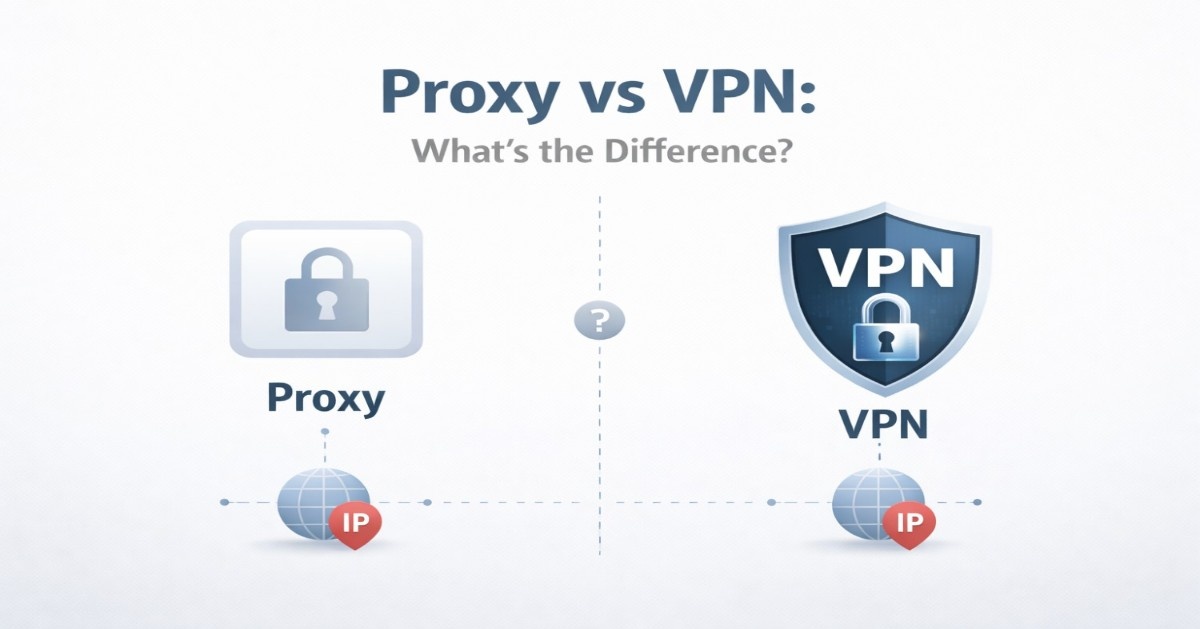
VPNs will encrypt all traffic out of your device and substitute your visible IP address. In comparison, proxies usually provide you with anonymity only when it comes to a particular application, and sometimes fail to encrypt the data on top. The actual difference between the two is determined by that distinction, that which is encrypted and to what scope. A VPN creates an encrypted tunnel for all your online activities. A proxy is just a server that relays specified traffic to another server. Both will allow going around IP-based restrictions. There is only a single meaningfully secure way of protecting your data in transit.
It is much simpler to decide, which is possible only by understanding how each tool works, or on what marketing proclaims it to work.
What is a Proxy Server and how does it work?
A proxy server is a server that can be used as a middlepoint between your computer and the rest of the internet. You do not connect to a site, but send your request to the proxy. The proxy, in turn, relays that request to the destination server. The proxy addresses the IP address of the proxy and not you, making your veritable whereabouts largely undisclosed.
This IP replacement is able to circumvent fundamental geo-blocking or network blocking. Nevertheless, the majority of proxies fail to encrypt the traffic between you and the proxy server. It implies that your local network provider, your local network administrator, or anyone sniffing the network path between you and the proxy will be able to read your plaintext.
That is, a proxy conceals your identity to the receiving location. It does not necessarily protect the message you are transmitting.
The various types of proxies work at various levels:
HTTP Proxy: Browser traffic (HTTP/HTTPS). Caching or bypassing regional restrictions is often used as a content filter.
SOCKS5 Proxy: It operates lower level and is compatible with various types of traffic – email, torrenting, gaming, and others. It is not very rigid and usually does not encrypt data.
Transparent Proxy: Snorts traffic without user setup and, in most cases, does not conceal IP addresses. A typical feature of a corporate or academic setting.
Reverse Proxy: It is placed in front of the servers so that it can control the incoming requests and also load balance or cache.
In the case of individual users, HTTP and SOCKS proxies are the most applicable. In any case, the proxy has no effect on traffic that has not been explicitly configured to use it. System-level applications and traffic are not secure.
The working process is simple:
- The proxy server receives a request from your device.
- The proxy requests that of the destination website.
- The reply goes back to the proxy.
- It is relayed by the proxy to you.
Your actual IP is never accessed. However, your traffic is not encrypted and can still be seen on the way unless encryption is applied on top of it (e.g., HTTPS in the browser), then your traffic is encrypted in transit.
Proxies are useful devices. They are not in themselves complete privacy solutions.
Types of Proxy Servers
There is a wide variety of proxies in terms of reliability, anonymity, and security:
HTTP Proxy: Routes browser traffic. Can filter or cache content. Usually employed to break region locks.
SOCKS5 Proxy: Both protocol-agnostic and has a wide range of supported traffic types. Commonly applied in sharing or streaming P2P. Lacks nothing in encrypted information.
Transparent Proxy: Sniffs traffic, but does not mask IP addresses. Mainly used either to monitor or filter.
Residential Proxies vs. Datacenter Proxies:
- Datacenter proxies are quick and simpler to detect and block
- Residential proxies utilize IPs assigned by the ISP and are more difficult to detect, but in general,l slower and more costly.
Private vs. Public Proxies:
- The use of a single-user proxy is known as a private proxy.
- Free or public proxies are shared and are often unreliable – some of them log, inject ads, or sell user data.
Eset up is a trade-off. Security is usually compromised with improvemenin of speed. Anonymity can be greatly reliant on the operator of the proxy. As long as you do not encrypt your connection, your data will be open.
The proxy servers are also classified based on who the proxy server serves:
Forward Proxy: This is located on the client-end of the connection. Customers set their device or browser to utilize it. It captures outgoing requests and redirects them. The IP of the client is not visible to destination servers; only the IP of the proxy is visible. Content filtering, caching, anonymity, or overcoming restrictions are done using forward proxies. Indicatively, the forward proxy of a company may block social networks or record the use by employees of the web.
Reverse Proxy: It is located on the server end (perimeter of a web server network). Client requests to a site are sent to the reverse proxy, where they are sent to one or more backend servers. Clients can only see the proxy IP, and not the IPs of the internal servers. Reverse proxies enhance load balancing, termination of SSL, caching, and security of web servers. As an example, a reverse proxy is able to redirect traffic entering the servers to a number of web servers and prevent bad requests before they reach the actual servers.
The essential differences: A forward proxy is in the best interests of the client (to protect/ hide the clients), whereas a reverse proxy is in the best interest of the servers (to hide and balance the servers). Forward proxies permit the outgoing policy to be controlled; reverse proxies are economical and secure the incoming traffic.
What is a VPN and how it operates?
A VPN is a secure tunnel between your device and a VPN server. After the establishment, all internet traffic, browser sessions, applications, and downloads are sent through said tunnel. Sites access the IP address of the VPN server and not yours.
Encryption is the characteristic feature. Strong cryptography ciphers (AES-256 or ChaCha20) are used in VPNs to secure data during transmission. On public Wi-Fi, this matters. Unless encrypted, network-level attackers can always monitor or decrypt traffic. The data intercepted cannot be read using a VPN.
The general procedure of VPN is as follows:
Connection: Your device authenticates itself with a VPN server over a protocol like OpenVPN or WireGuard.
Encryption: Data is encrypted before being sent out of your device.
Tunneling: Coded packets are transferred safely to the VPN server.
Forwarding: The VPN server decrypt traffic and directs it to the destination site using its IP address.
Return Path: The VPN server encrypts (responses) and is relayed back through the tunnel.
This occurs repeatedly while the tPN is running.
The major and reliable VPN providers have applications on Windows, macOS, iOS, Android, and in some cases, routers. Installing at the router level protects all the network devices – smart TVs, gaming consoles, IoT devices – even if the device does not itself have the ability to execute VPN software.
VPNs are commonly used for:
- Obtaining Wi-Fi networks in the open.
- Evading the monitoring of ISP traffic.
- Logging in to the limited area content.
- Remote corporate access
- Avoiding bandwidth snuffing.
The most important difference from a proxy is the full encryption and coverage over the entire device.
Types of VPN: Remote-Access and Site-to-Site
There are two basic deployment types of VPN:
Remote-Access VPN (Client VPN): It is a system that enables individual users to safely access a private network at any location.
Normal use case: a worker working at home uses a VPN client application on their laptop in order to connect to the corporate network. It uses self-encrypted tunneling to the VPN server of the company. It is a user-induced temporary connection.
Site-to-Site VPN (Router-to-Router VPN): This is a permanent, encrypted connection between two (or more) networks.
As an illustration, the router at Office A and the router at Office B will create a tunnel that will unify the two LANs into a single virtual network. The devices of Office A are able to access the resources of Office B transparently. This is typical with connections between branch offices and headquarters.
Major distinctions: Remote-access VPNs are used by remote workers, need client software, and every user is required to create their own tunnel. Site-to-site VPNs are used across whole networks, need no per-user configuration (the routers do the work), and have a single tunnel that links the offices. RAVPNs can commonly operate with both of the following protocols: SSL and IPsec, and most site-to-site VPNs also use IPsec to provide strong encryption.
Where to apply all of them: remote-access VPN is to be used by telecommuters or road warriors who require secure access to a network, no matter where they are. Install a site-to-site VPN where you have several fixed office sites that require the sharing of resources (file servers, printers) as though on a single network. They can even be deployed in hybrid configurations, yet each is suited to various situations.
VPN Pros and Cons
Pros
Powerful Encryption: Defends against Eavesdropping and Network attacks.
Full-Device Protection: Ensures all applications at the same time
IP Masking: Hides the location from the websites and network observers.
Advanced Features: Kill switches, split tunneling, DNS leak protection, and multi-hop routing.
Cross-Platform: Applications on almost all major devices, such as routers.
Cons
Speed Impact: There is a possibility of a small latency added by encryption and rerouting.
Subscription Cost: The premium VPNs are usually paid services.
Complexity of Setups: It involves software installation and management.
VPNs are more powerful in terms of privacy and security options despite trade-offs, as they are.
Proxy vs VPN: Key Differences
The variations are not cosmetic but structural.
Encryption
VPNs are capable of encrypting all traffic over strong cryptographic standards. Normal proxies do not encrypt data between one end and the other. The proxy can still intercept sensitive information that is sent.
Scope
Upon connection, VPNs safeguard all traffic in the system. Proxies have an impact on the configured application.
IP Masking
Both mask IP addresses. A VPN does so system-wide. A proxy does so selectively.
Speed
Proxies can offer fewer overheads, as they can usually bypass encryption. VPNs introduce cryptographic processing, but current protocols,s such as WireGuard, enable performance degradation only to a minimum.
Privacy Practices
Free proxies also tend to log or to monetize users’ data. VPN companies generally market no-log policies, and consumers are left to believe the infrastructure and transparency practices of the provider.
Cost
Trustworthy VPNs tend to need subscriptions. Free or cheaper proxies can be used, but reliability and privacy can be compromised.
In a real-world scenario, VPNs offer the benefit of layered protection. Proxies offer a simple replacement of IP.
| Feature |
VPN |
Proxy |
| Encryption |
Yes – Encrypts all device traffic (AES-256 or ChaCha20) |
No – Typically just relays data (no built-in encryption) |
| Coverage |
Protects all apps and services on the device |
Only affects configured apps (often just the browser) |
| IP Address Masking |
Masks IP for all internet connections |
Masks IP only for the proxied traffic |
| ISP / Network Tracking |
Prevents ISPs from seeing browsing activity (full tunnel encryption) |
ISP can see activity except the proxied destination IP |
| Speed & Performance |
Slight overhead from encryption; optimized VPNs minimize slowdown |
Typically faster due to no encryption, but can be inconsistent |
| Privacy & Logs |
Often follows strict no-log policies (higher anonymity) |
Frequently logs user data, especially free proxies |
| Best Use Case |
Secure browsing, streaming, public Wi-Fi, remote work, business access |
Quick IP change or bypassing geo-blocks for a single app |
This table highlights that VPN provide encrypted, system-wide protection, while proxies offer basic IP hiding for specific tasks. For example, with a VPN, your ISP cannot see what you do online, but a proxy leaves your DNS and non-proxied traffic exposed. On speed, proxies might feel quicker since they lack encryption, but they lack VPNs’ robustness and privacy features.
When to use a VPN
- You require guarded security within the publicly-run systems.
- You desire a system-wide coverage of various apps.
- You do not want to be monitored/throttled by ISPs.
- You need more such features, such as kill switches or split tunneling.
- If it is sensitive information that you are dealing with.
When to use a Proxy
- You require a temporary IP change for a certain task.
- Encryption is unnecessary.
- You are doing auto-Rotation or scraping work, which can be useful with rotating IP pools.
- You would like a cheap, short-term fix.
Avoid Proxies if:
- Your goal is strong privacy.
- Unencrypted traffic is still visible to ISPs, and free proxies often sell user traffic.
Avoid VPNs if:
- All you require is a single IP change, and you’ll like a lean solution
- Gaming scenarios can also have low latency as a priority, and most VPNs are currently game-optimized.
A VPN is the default option of greater suitability to most security-conscious users.
Additional Considerations
DNS Leaks
Not all proxies support routing of DNS queries, so your ISP is still able to view domain lookups. To avoid it, VPNs normally utilize their own DNS server.
WebRTC Leaks
IP addresses can be revealed through WebRTC using browsers. At the system level, these leaks are normally addressed through VPN applications.
Streaming Detection
Streaming websites have an active policy of blocking any IP range of well-known proxies and VPNs. Success in infrastructure rotation is inconsistent; providers rotate to counter detection.
CDN and Anti-Abuse Detection
Massive traffic using proxy IPs is mostly flagged. The residential or personal infrastructure minimizes detection risk.
Smart DNS
Smart DNS makes changes in location-check requests only. It does not encrypt traffic or alter your IP, bringing it closer to a lightweight proxy.
Router-Level Protection
VPNs have the ability to protect a whole home network at the router level. Proxies generally cannot.
Proxy vs VPN: Case Discussion
The decision on whether to use a proxy or VPN is very dependent on the situation. Some real-life examples to inform the decision are discussed below, together with setups suggested and troubleshooting hints.
In this case, we will connect two offices in different locations using a VPN that operates on an IPSec (Internet Protocol Security) platform.
Scenario: A company has several office sites that require sharing servers and resources as though under the same network (e.g., file servers in HQ are used by branch offices).
Solution: A site-to-site VPN is the best. It is a tunnel between network gateways (routers or firewalls) at one end of the network and the other. It provides a safe connection between the two LANs via internet. Inter-office, the devices can be accessed by the users of one office by the other office through the use of private IPs
Setup Steps:
- Each office has a VPN gateway (a router or a firewall), which is configured with similar VPN settings (same IPsec protocol, same encryption algorithm, such as AES-256, and pre-shared key or certificates).
- Assign local subnets to the gateway of each office. Make sure that the subnets are not overlapping (e.g., Office A: 10.0.1.0/24, Office B: 10.0.2.0/24).
- Additional static routes may be necessary on each router to direct the traffic to the subnet of the opposite office to the VPN tunnel interface.
- Make sure that the upstream firewalls or NAT devices redirect the VPN ports (e.g., 500, 4500 using UDP in combination with IPsec to the gateway.
Troubleshooting Tips:
Connection Status: Make sure that the VPN status on the gateway of both gateways is “UP”. Otherwise, ensure similar settings and pre-shared key corrections are made.
Subnet Overlap: When data can no longer reach the opposite end, make subnets different – overlapping IP address blocks will cause routing to fail.
Routing: In case of failure in pinging the remote subnet, ensure that the devices in each office have the VPN gateway as their route. Devices will have to be aware of when to send remote-office traffic to the VPN router.
Firewall/NAT: In case the tunnel is not establishing, make sure that there are no intermediate firewalls/NAT that block VPN protocols. Win 809 (Win) is commonly an indication that the VPN connection is being blocked by a firewall or NAT.
Logs: Scan gateway logs on negotiation failures. According to the guide provided by Cisco Meraki, one ought to check the VPN status page and make sure that the right subnets are activated in Site-to-Site VPN settings.
FAQs
Is a proxy the same as a VPN?
No. A proxy forwards selected traffic and usually does not encrypt it. A VPN encrypts all device traffic through a secure tunnel.
Should I combine a proxy and a VPN?
Generally unnecessary. A VPN already masks IP addresses and encrypts traffic. Adding a proxy rarely provides a meaningful benefit.
Are free VPNs or proxies safe?
Many free services log or monetize user data. Free VPNs often impose bandwidth limits. Paid, reputable providers typically offer stronger privacy assurances.
Can a proxy protect public Wi-Fi use?
No. Without encryption, your traffic can still be intercepted.
Is a VPN always better?
For privacy and security, yes. For simple IP substitution without encryption needs, a proxy may suffice.
Conclusion
Both proxies and VPNs alter how your traffic appears online. Only a VPN encrypts it end-to-end and protects every application simultaneously. Proxies remain useful tools for specific tasks — IP rotation, lightweight geo-spoofing, automation workflows — but they are not substitutes for encrypted security.
If the objective is meaningful privacy, especially on public or untrusted networks, a VPN is the appropriate choice. If the goal is simply to test location-based content or rotate IPs for non-sensitive tasks, a proxy may be adequate.
Choose deliberately. The difference is not cosmetic — it is architectural.
To compare privacy tools in detail and understand how different VPN technologies work in real-world scenarios, explore the in-depth guides and technical resources available at vpnguider. The site provides structured explanations, setup tutorials, and security-focused comparisons to help you choose the right solution based on your needs rather than marketing claims.