 Why trust VPN Guider
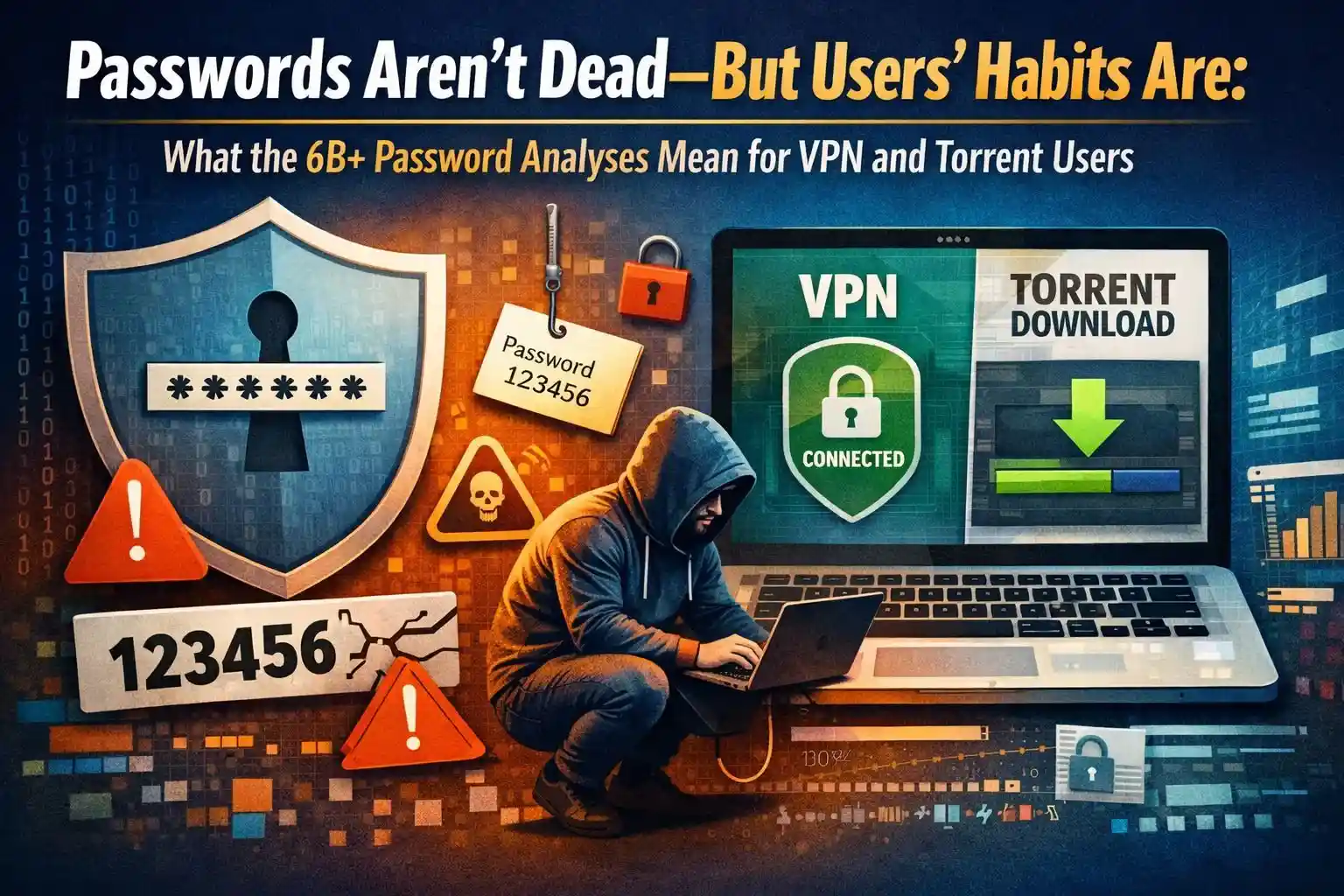
A trove of billions of leaked credentials — and multiple industry analyses of these caches — reveal an uncomfortable truth: despite relentless headlines and improving defensive tech, human password behaviour has barely evolved. For users who depend on VPNs and torrenting workflows, the implications are simple but urgent: network-level privacy is essential, yet it cannot compensate for recycled, weak, or reused credentials. Recent reporting and research into large credential dumps underline why password hygiene and modern authentication must be part of any privacy-first playbook.
The headline numbers — what the data shows
In 2025, researchers uncovered enormous aggregated datasets containing billions of username/password pairs. While the exact totals and provenance are discussed and debated among analysts, the practical takeaway is unambiguous: offence still outpaces defence when credential-stealing malware, combolists and historical leaks are aggregated and weaponized. These collections make credential-stuffing and account takeover attempts trivially scalable for attackers.
A separate, large-scale analysis of real-world login attempts found that a very large share of successful logins used credentials that had already been exposed elsewhere — a clear sign that password reuse remains endemic. The result: one compromised password can domino into many breached accounts.
Why VPNs and torrenters must pay attention (not panic)
It’s tempting to assume that a VPN — by masking your IP — removes most risk. That is false. VPNs protect network-level metadata (IP addresses, routing), but they do not stop credential harvesting on the endpoint, nor do they negate the danger of reused passwords. If an attacker obtains a set of valid credentials (by scraping leaks or buying combolists), they will attempt logins across multiple services — and a VPN does not prevent those attacks from succeeding if the credentials are valid.
For torrent users, the risk vector is specific: torrent communities, trackers, and related accounts often use the same email/password combinations people use elsewhere. A leaked credential that grants access to a tracker or forum can also reveal IP histories, private messages, or seeded file lists — so the data leakage is operationally useful to attackers. Segmentation, unique credentials, and layered defences matter.
What “stagnant user behaviour” looks like (and why it persists)
- Reuse & recycling: Simple patterns and repeated passwords remain pervasive. Shortcuts like appending “123” to a base password are still common and still crackable.
- Overreliance on memory: Users resist managers and passkeys because of friction or mistrust, even though those tools measurably reduce account takeover risk.
- MFA misunderstandings: People enable SMS MFA and assume they’re safe — but SMS is vulnerable to SIM-swap and phishing; hardware keys and platform MFA are more resilient.
These habits endure because of cognitive load: users manage dozens (or hundreds) of accounts and opt for convenience over security — until a breach makes the trade painfully obvious.
Concrete actions for users (prioritized, practical)
- Adopt a password manager and move to unique, random passwords. Password managers eliminate the memory burden and make credential reuse obsolete. They also facilitate safe password rotation when breaches are disclosed.
- Enable phishing-resistant MFA where possible. Use authenticator apps, platform-bound MFA (device biometrics), or security keys (FIDO2) instead of SMS. These options materially reduce account-takeover risk.
- Start migrating high-value accounts to passkeys. Passkeys (device-backed public/private key pairs) remove passwords from the equation entirely and are phishing-resistant. Rollout is accelerating among major providers.
- Segment identities for torrenting: Create separate, unique accounts for torrent trackers and community sites; avoid using the same credentials you use for email, banking, or development platforms. Consider burner emails or aliases for low-value services.
- Monitor and rotate on detection: Use breach-monitoring services (or built-in manager breach alerts) and rotate credentials immediately when an exposure is reported. Treat any alert about one of your credentials as systemic — not isolated.
Product & policy levers your VPN/torrent company can use
If you’re publishing this on your company blog, add actionable company-level commitments and user-facing features:
- Breach-intel integration: Offer an optional service that warns users if their corporate or account email appears in known leaks (with clear opt-in and privacy controls).
- Onboarding that nudges security: During sign-up, guide users to enable passkeys/MFA and offer a quick link to recommended password managers.
- Educational UX: Produce short in-app tutorials: “How to use a password manager with our client” and “How to enable our kill-switch and why it matters.”
- Safety defaults: Ship client defaults that prioritize security (kill-switch on, DNS leak protection enabled) and provide a one-click diagnostic for common misconfigurations. These reduce the window of exposure when credentials are abused.
A realistic roadmap for “password retirement.”
Passwords won’t vanish overnight. The sensible pathway for organizations and power users is incremental and layered:
- Reduce reliance: Encourage managers, passkeys, and strong MFA wherever feasible.
- Protect the endpoint: Educate users about browser security, extension hygiene, and malware vectors that can harvest credentials.
- Detect & respond quickly: Use breach-detection feeds and automated forced-rotation prompts when a verified leak affects your user base.
This triage — reduce, protect, react — places the burden away from human memory and onto resilient systems.
Closing: network privacy helps, but credential hygiene wins the long game
For VPN and torrent users, the headline is neither apocalyptic nor trivial: a properly configured VPN preserves network privacy, but it cannot defend the secrets you hand to the internet. The stream of multibillion-password analyses should be a wake-up call to combine network anonymity with modern authentication: unique credentials, manager-backed randomness, phishing-resistant MFA, and a pragmatic adoption of passkeys. That is how we get from “stagnant behaviour” to measurable resilience.