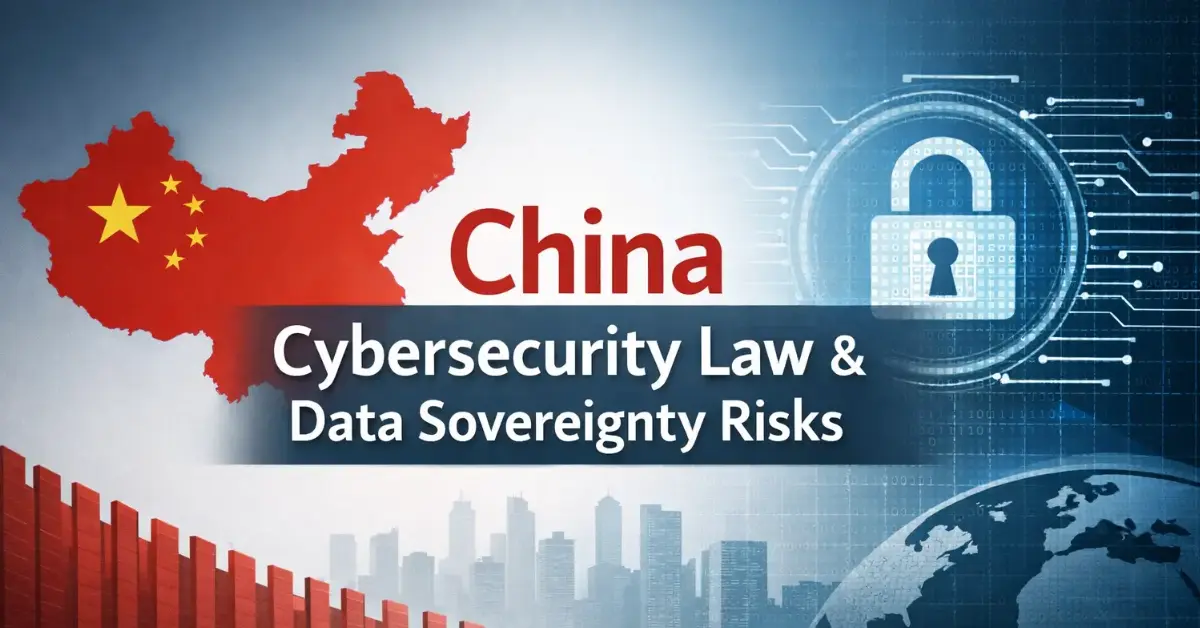
China’s Cybersecurity Law is transforming global data governance. It enforces strict data sovereignty and imposes new compliance obligations on international businesses and technology companies. According to Chinese law, data generated in China must remain within its borders. Notably, changes to the Cybersecurity Law were announced on January 1st. As a result, international businesses operating in or with China now face serious risks.
These amendments subtly conflict with the Trump administration’s policy against international regulations that restrict the free movement of data across borders. I recently discussed China’s so-called “Legal Great Wall.” It poses a threat to American companies and those working with Chinese entities. Therefore, to protect American individuals and businesses from totalitarian control, it is essential to oppose China’s strict data sovereignty rules.
China's Cybersecurity Law regulates how data is stored, protected, and transferred in China. It requires companies to store certain data locally and follow strict cybersecurity and compliance rules.
How does the China Cybersecurity Law affect international businesses?
It requires international businesses to store data in China, follow security reviews, and comply with strict regulations. Non-compliance can lead to fines, sanctions, or operational restrictions.
What is data sovereignty in China?
Data sovereignty means data generated in China must be stored and managed under Chinese law. Cross-border data transfers are restricted and require government approval.
Can foreign companies be penalized under China's cybersecurity law?
Yes, China can penalize foreign companies if their activities affect China’s cybersecurity. Penalties may include fines, sanctions, or business restrictions.
Why is the China Cybersecurity Law important for global tech companies?
It impacts how companies store and transfer data, increases compliance costs, and creates legal risks for businesses operating in or working with China.
The Trump administration prioritizes the free movement of data across borders and opposes foreign regimes that restrict it. It argues that global data flows are vital for AI research, technological competition with China. And, also for the advancement of American business interests abroad. U.S. tech firms are concerned about data sovereignty because building large AI models requires access to diverse and extensive datasets.
Data localization rules mandate the storage and processing of a country’s resident or company data within its borders. Consequently, these rules hinder the growth of U.S. AI companies. They require costly infrastructure, add legal burdens, and fragment global data pools. An early executive order highlighted that foreign laws restricting data sharing violate American sovereignty. Such restrictions make competition harder, raise costs, and increase risks to sensitive data. There are also signs that the Trump administration may take decisive action to defend American interests against these foreign laws.
Chinese Data Sovereignty Model Is Spreading
The United States is concerned that China uses its data and cyber laws as tools of authoritarianism. Furthermore, China is attempting to export this model. Through its Belt and Road and Digital Silk Road initiatives, China is building infrastructure partnerships with developing countries worldwide. In doing so, it exports data regimes and technologies that support authoritarian objectives. For example, DeepSeek, China’s AI model, promotes the Chinese Communist Party’s views and suppresses information. This includes details about the Tiananmen Square massacre. Thus, China is not only exporting technology—it is also spreading an anti-freedom mindset.
Chinese Cyber Defense, Data Sovereignty, and Technology Regulation
China uses cyber and technology regulations as a form of “lawfare”—legal warfare—to expand its geopolitical influence. The “Legal Great Wall” consists of over twenty laws recently enacted for national security. Many of these laws have extraterritorial effects or appear to legitimize illicit activities abroad. According to the National Counterintelligence and Security Center, U.S. companies doing business with China must comply with eight such rules.
A Triangle of Laws for Data Protection in China
China’s new regulations allow the government to monitor international businesses closely and potentially access more of their data. These confidentiality rules also impact U.S. firms and individuals. The Cybersecurity Law, Data Security Law, and Personal Information Protection Law (PIPL) set strict data localization requirements. And, they also impose tough penalties for violations. Businesses must now undergo privacy reviews. The PIPL controls the transfer of personal data inside and outside mainland China, particularly when companies sell to Chinese citizens. Additionally, it limits Chinese companies’ ability to collect and store personal information while allowing the government to gather data for purposes it considers in the public interest. The Data Security Law gives China the power to restrict or deny cross-border data transfers. And, also imposes strict rules on these flows.
China’s Cybersecurity Law and Its Impact on Global Companies
On January 1, new updates to China’s Cybersecurity Law took effect, making these concerns even more urgent. The law now imposes higher fines for violations. More importantly, it broadens the scope of extraterritorial enforcement. Now, China can target foreign actions that affect its cybersecurity or have significant domestic impacts, not just those involving critical infrastructure. Previously, the government could only target foreign threats to key infrastructure.
Now, China can impose sanctions, freeze assets, and penalize U.S. corporations. This includes parent companies, cloud providers, and third-party vendors if it believes they pose a threat to its cybersecurity. These measures could apply even to companies with no offices in China. As a result, China’s Great Wall can obstruct data discovery, potentially affecting lawsuits involving U.S. firms. So far, U.S. courts have rejected Chinese companies’ attempts to use these laws to block discovery requests. However, such efforts still delay dispute resolution.
Response to China’s Stringent Data Sovereignty Laws
China’s cyber and digital strategies pose a strategic threat to the United States. China’s data sovereignty laws endanger the free flow of information. However, it is vital for First Amendment rights, the constitutional guarantee of free speech, and the U.S. economy. In 2022, the United States, Mexico, Canada, Australia, and Japan created the Global Cross-Border Privacy Rules Forum. This group promotes data flows and strong privacy protections worldwide. The U.S. should remain active in this forum and advocate for better regulations.
Additionally, the U.S. should work with allies to warn other countries about the risks of Chinese technology. Moreover, it should offer affordable alternatives to China’s restrictive exports. To achieve these goals and protect Americans from China’s data sovereignty trap, collaboration with the private sector is essential.
Conclusion
China’s Cybersecurity Law is reshaping global data governance by enforcing strict data sovereignty and expanding regulatory control. As these regulations continue to evolve, international companies must strengthen compliance strategies and adapt to China’s legal framework. This approach will help reduce risk and maintain uninterrupted global operations.
A passionate content writer with four years of experience delivering high-quality content across multiple domains. I believe in writing that informs, connects, and adds value.